textstream.blogspot.com has moved to blog.gerstein.info
This blog has moved to blog.gerstein.info .
The posts below are kept for simply archival purposes and to prevent broken links.
This blog has moved to blog.gerstein.info .
The posts below are kept for simply archival purposes and to prevent broken links.
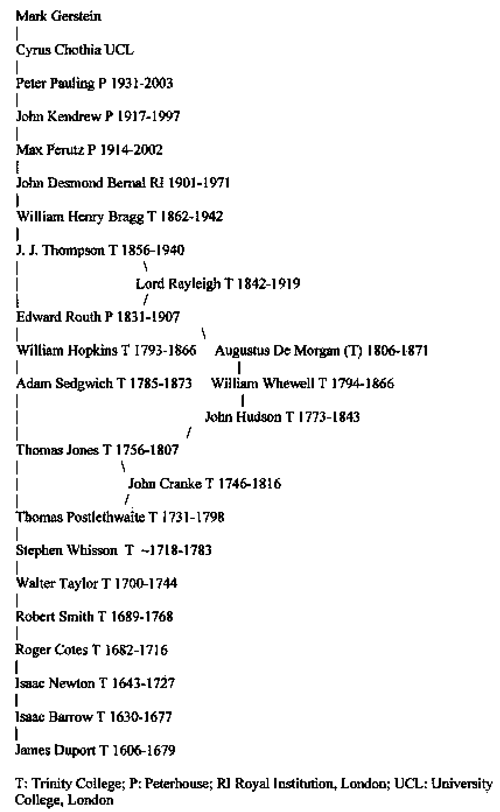
Link to the Mathematics Genealogy Project
Image of my academic genealogy back to Newton , with a mere 18 links ! (courtesy of C Chothia)
**1.** Mark Gerstein
2. Cyrus Chothia UCL (+ R Lynden Bell)
3. Peter Pauling P 1931-2003
4. John Kendrew P 1917-1997
5. Max Perutz P 1914-2002
6. John Desmond Bernal RI 1901-1971
7. William Henry Bragg T 1862-1942
8. J. J. Thompson T 1856-1940
- - - I Lord Rayleigh T 1842-1919
9. Edward Routh P 1831-1907
10. William Hopkins T 1793-1866
- - -Augustus De Morgan (T) 1806-1871
11. Adam Sedgwich T 1785-1873
- - - William Whewell T 1794-1866
- - - John Hudson T 1773-1843
12. Thomas Jones T 1756-1807
- - - John Cranke T 1746-1816
13. Thomas Postlethwaite T 1731-1798
14. Stephen Whisson T ~ 1718-1783
15. Walter Taylor T 1700-1744
16. Robert Smith T 1689-1768
17. Roger Cotes T 1682-1716
**18.** Isaac Newton T 1643-1727
Isaac Barrow T 1630-1677
James Duport T 1606-1679
T: Trinity College; P: Peterhouse; RI Royal Institution, London; UCL: University College, London
 Labels:
bioinformatics,
doc,
fact,
fun
Labels:
bioinformatics,
doc,
fact,
fun
We read with great interest the recent article in Nature about the
difficulties in data sharing and archiving ("Empty Archives"). While the author discusses database archiving in detail, he neglects to consider the important archival role
served by academic journals. When it comes to archiving, journals are
more than disinterested third parties. They have historically been, and
continue to be, the central actors in scientific communication. As such,
journals should take the lead in devising and implementing standards
that will allow data from disparate fields to be shared and exchanged.
They should also embrace data sharing as part of the publication
process. Note that this is very much the viewpoint taken in the
companion article in the issue from the Toronto Data Release Workshop.
Although journals have historically sought to provide a permanent record
of scientific advance, many of the problems that we now face in relation
to data archiving and sharing stem from the fact that the publication
process with its varied, idiosyncratic formats often seems purposefully
divorced from this archiving role. It is time for journals to devise
universal structured versions of articles and appendices that
accommodate - and archive -- large data sets. This is no small task, and
it is no doubt larger than any one journal or editorial board. But
while daunting, such progress is necessary to preserve the value and
relevance of journals - and the fundamental service they provide - as we
move into a database-driven future.
Dov Greenbaum JD, PhD
Michael Seringhaus PhD
Mark Gerstein PhD
Labels:
L2E,
UnpublishedLetter
Here I've collected various things related to some trips to Europe in 2009.
* Pictures
Flickr photos galleries from London in Jan., Belgium in Oct., and Paris & Cambridge in Dec. (The analogous links in picasa: London, Belgium, & Paris .)
In addition to the usual tourist shots, I took some fairly abstract photos and some more general "concept" ones. My photos also added significantly to my burgeoning McDonald's photo collection.
* Tags & Routes
I tagged my photos quite extensively. Here's a listing of some of my more commonly used tags on the trips. One 'tag group' that was particularly hard to shoot were the panoramas and nighttime photos , where I was aided by my trusty new Sony. Here's an almost 360' panorama of the Louvre.
As might be expected, I geotagged many of the photos as well; thus, each of these galleries is associated with a nice map link -- e.g. here's an one for Paris . The geotagging has the side benefit of providing some tracks of where I went, viz: walking around Paris, Paris to London (via Chunnel), & walking around London (not necessarily in order).
* Links & Lectures
Here's a general collection of links of random information associated with the trips.
Some lectures that I gave during the trips: 1a, 1b, 2, 3, 4
Some of my own cryptic internal IDs with yet more links: i0wtsysbio, i0gencwinter08, i0vib
Labels:
fun,
FunTaggedTrips,
routes-timings
Some quotes I liked from: http://www.newyorker.com/reporting/2009/10/05/091005fa_fact_cassidy
For more see: http://delicious.com/mbgmbg/clust_bridge_keynes_quotes
Millennium Bridge
It initially closed in '00 then reopened: "The real problem was that the designers of the bridge... had not taken into account how the footway would react to all the pedestrians walking on it."
Keynes view on our "third degree" guesses
Keynes’s jaundiced view of finance reflected his own experience as an investor .... He compared investing to newspaper competitions in which “the competitors have to pick out the six prettiest faces from a hundred photographs, the prize being awarded to the competitor whose choice most nearly corresponds to the average preferences of the competitors as a whole; so that each competitor has to pick, not those faces which he himself finds prettiest, but those which he thinks likeliest to catch the fancy of the other competitors, all of whom are looking at the problem from the same point of view.... It is not a case of choosing those which, to the best of one’s judgment, are really the prettiest, nor even those which average opinion genuinely thinks the prettiest... We have reached the third degree, where we devote our intelligences to anticipating what average opinion expects the average opinion to be. And there are some, I believe, who practice the fourth, fifth and higher degrees.”
Points on the Prisoner's dilemma
Because financial markets consist of individuals who react to what others are doing, the theories of free-market economics are often less illuminating than the Prisoner’s Dilemma, an analysis of strategic behavior that game theorists associated with the RAND Corporation developed during the early nineteen-fifties....
Imagine that you and another armed man have been arrested and charged with jointly carrying out a robbery. The two of you are being held and questioned separately, with no means of communicating. You know that, if you both confess, each of you will get ten years in jail, whereas if you both deny the crime you will be charged only with the lesser offense of gun possession, which carries a sentence of just three years in jail. The best scenario for you is if you confess and your partner doesn’t: you’ll be rewarded for your betrayal by being released, and he’ll get a sentence of fifteen years. The worst scenario, accordingly, is if you keep quiet and he confesses.
What should you do? The optimal joint result would require the two of you to keep quiet, so that you both got a light sentence, amounting to a combined six years of jail time. Any other strategy means more collective jail time. But you know that you’re risking the maximum penalty if you keep quiet, because your partner could seize a chance for freedom and betray you. And you know that your partner is bound to be making the same calculation. Hence, the rational strategy, for both of you, is to confess, and serve ten years in jail. In the language of game theory, confessing is a “dominant strategy,” even though it leads to a disastrous outcome.
Labels:
quote,
textstream_blog_additional_info0mg
We read Katrina Voss's article on open access to genomic information (22 August, p 22) with great interest. Summing up her argument, she quotes her father: "I'm not worried, I'm just not that important."
Narcissists aside, we can all agree that we aren't that important to the rest of the world. However, what Voss fails to account for is the small cadre of people to whom we are that important. This set includes friends, relatives, employers, potential mates, and even stalkers who already look at the wealth of information available online.
One instance where this data could be misused would be by adopted children, or even the children of sperm donors, to find parents who might not want to be found.
Similarly, certain professions could be affected from the outset. Genomics has the potential to touch all aspects of sport, from using genetic information for draft picks, to mandatory genetic testing to screen out players at all levels of the game at risk of serious and unanticipated ailments.
With the growth in understanding the links between athleticism and genetics, public disclosure of personal genomic information of athletes may be just a logical extension of what is already in place. Analysing how athletes deal with this new form of personal information will be of particular interest to the rest of society as it learns how to manage the eventual disclosure of personal physical and genetic information.
Dov Greenbaum & Mark Gerstein, New Haven, CT
Labels:
L2E,
PublishedLetter
Supposedly....
Turtle is symbol of:
Patience longevity connection
Rabbit is symbol of:
Patience quick thinking timidity ingenuity fertility
Salmon is symbol of:
Determination fertility wisdom prophecy
Frog is symbol of:
Transformation creativity fertility water
Labels:
quote
I would like to respond to the recent article on the relationship between cellphone and other portable device usage and driver safety. I full agree with the premise of this article that this is a dangerous new phenomenon. However there are a number of connections that could have been probed a bit further. In particular, are there any instances when one is using a cell phone when driving that are actually safer than driving without one? That is, one could imagine that a drowsy driver on a dark street might have a easier time keeping alert and concentrating if he was carrying on a conversation over a cellphone rather than driving alone? Also, the implication of the article was that talking to someone on the cellphone is more dangerous than talking to a fellow passenger in the car. I do not know if this is always the case -- as anyone who has experienced a bunch of rambunctious young children in the car might attest to.
Labels:
L2E,
UnpublishedLetter
Schmidt & Schwarz’s article raises serious concerns regarding the use of DNA testing in baseball. It is likely, however, that these concerns represent only the tip of the iceberg. Teams invest millions in their players; given this, would an owner pass up the opportunity to learn more about a player’s long-term potential through a relatively cheap genome analysis? Further, baseball, like many professional sports, sustains a strong statistics subculture that will likely see genetic testing as an integral component of a player’s dossier (along with height, weight and say ERA). In a worst case scenario, this testing would ignore the significant privacy concerns -- both to the individual and their family that share’s much of the same genes -- resulting from the disclosure of a person’s genetic predispositions. It could be even done surreptitiously by a fan or rival based on trace DNA remains lifted off of personal items.
Dov Greenbaum JD MPhil PhD
Mark Gerstein, PhD
Labels:
L2E,
UnpublishedLetter
I read with great interest the recent editorial advocating health care reform by the government. It is certainly impressive to see is the President writing in the Times. One thing in that was especially notable was that in one paragraph the President calls for insurance companies to pay for mammography and colonoscopy and the following sentence points how this will reduce the incidence of breast and prostate cancer. I wonder exactly how these two things are connected and to what degree these sentences show about the type of health and medical advice that the President is getting.
Labels:
L2E,
UnpublishedLetter
I read with great interest the recent article describing the issue where medical school professors have articles ghost written for them by writers commissioned by drug companies. The article pointed to the obvious conflict of interest -- and the way that drug companies were using this to unfairly market their products. It also pointed a finger at granting agencies and universities to somehow crack down on this behavior. While I agree that this is certainly a problem, I wonder whether it might make more sense to focus on journalists and publishers. Should it not be the case that an article can only be accepted into a reputable scientific journal if all the authors have been declared (i.e. no ghostwriters) and that the roles of each of these individuals and their conflicts are described somewhere in the text? I think this simple step would do a lot to clean up this problem and many other problems in scientific publishing.
Labels:
L2E,
UnpublishedLetter
Routes (Overview image)
BikeNFairfield [28-Jun-08]
BikeWestport [12-Jul-08]
BikeNWestport [14-Jun-09] (27 miles)
BikeGreensFarms [31-Jul-09] (~20 miles, cut short by rain) (Route is Google-Map KML ; also, route directly in Google Map)
BikeDarien [8-Aug-09] (~20 miles)
BikeNewCanaan [16-Aug-09] (21 miles)
Photos
General Flickr and Picasa collections (with map). Closeup on New Canaan .
Links
http://delicious.com/mbgmbg/FunBikeNFairfield
http://delicious.com/mbgmbg/FunBikeNWestport
http://delicious.com/mbgmbg/FunBikeWestport
See also earlier post on this subject.
Labels:
cycling,
FunTaggedTrips,
routes-timings
Just posted this in
Google Help > Picasa > Discussions > Picasa for Mac (Labs) > PC / Mac Compatibility
(http://www.google.com/support/forum/p/Picasa/thread?tid=0e2e942a3e7212d6&hl=en ):
I'm using a mac with OS X and running vmware fusion with windows XP. Despite what's being said above, I want, recklessly, to try and go back and forth between both windows and mac picasa. Each has some advantages -- i.e. the mac version is faster but the windows one handles geotagging. I find if I go back and forth with the current versions of the program (as of Aug. 2009), things actually kind of work. (This wasn't true with earlier versions.) However, after a bit of edits on the mac, the OS X version of picasa often will create two copies of each picture in a folder, one where my edits are not properly applied. This does not seem to happen to the PC copy. Refreshing the folder doesn't fix things. Moreover, checking the "hidden" picasa files (.picasa.ini file and .picasaoriginals on the mac) reveals that these are not duplicated in any way and don't seem corrupted. What's happening? One workaround that I discovered is that if I carefully do "Folder Menu: Remove from Picasa..." on the whole folder and then "File Menu: Add Folder to Picasa..." things are usually fixed. But I'd like a cleaner solution.
Labels:
ComputerNotes,
vmconfigt60b_xmg
Visiting Bay Area (+ Tucson)
Photos: Picasa, Flickr (including some shots of rows of grapes)
Google Maps: Running, Cycling
Lectures: 1, 2, 3, 4
Links
Visiting Seattle
Photos: Picasa, Flickr (including some shots of famous artworks juxtaposed on a map with analogous ones from the East Coast)
Google Maps: Cycling
Links
Labels:
cycling,
FunTaggedTrips,
routes-timings
I got an iphone recently and predictably I've been very interested in acquiring all sorts of applications. Here's my (ranked) list at the moment:
Most Useful
Google, Mobile Fotos, Night Stand, Yummy, FullScreen
Somewhat Useful
Google Earth, RK Free, NYTimes, Skype, Zillow
Not that Useful
RedDelicious, Trulia, iNapkin, RedLaser
(Suggestions to add to this list would be welcome.)
The above list was current as of the time of this post.
My continuously updated list is here.
Labels:
fun list
Dear Sir:
Misha Angrist's recent article astutely notes the states' misguided attempts to regulate personal genomics by treating the personal genomics product as more medical relevant than the data currently warrants. While Ms. Angrist sees these regulatory intrusions as somewhat benign, we see significant concerns: The state actions will effectively sanction those personal genomics companies that do meet the states' relatively low bar- sending a signal to consumers that it's ok to proceed impetuously; the State has your back! Similarly, Federal attempts assuage popular apprehension with genetic testing through the recently passed Genetic Information Nondiscrimination Act (GINA) will provide false security to those consumers concerned with their genomic privacy. Personal genomics raises many non-trivial privacy concerns that are as of yet unaddressed by either state or federal actions. Recreationally minded consumer oriented personal genomics companies that imprudently suggest that their customers share their genomic results often without concern for either their or their close relatives' (that share a large percentage of their genetic complement) medical privacy will expose their consumers current and potentially future genetic diseases and dispositions long before we even understand what the data means or how it can be used.
Dov Greenbaum JD MPhil PhD and Mark Gerstein, PhD
Labels:
L2E,
UnpublishedLetter
Ms. Harmon’s recent article surveying the expansion of warrantless collections of DNA is particularly thought provoking; Whereas, a simple fingerprint merely identifies the individual, unrestrained collecting of DNA can disclose personal and private information, irrespective of the relevance to the case or the guilt of the suspect.
With rapidly evolving DNA technology, it is now possible to extract vast amounts of genomic data from the biological miscellany that is continuously shed over our daily lives. Science can discern details of a person's appearance, latent diseases, and even personality traits from this genomic data, exposing not only the suspect’s personal information but their relatives’ as well.
As law enforcement collects and archives DNA, this link to personal information will be perpetuated and privacy never completely restored.
Any legal or ethical discussion ought to be cognizant of these very real concerns, especially with regard to data security and sharing protocols.
Dov Greenbaum JD, PhD and Mark Gerstein PhD
Labels:
L2E,
UnpublishedLetter
Dear Sir:
Allen Salkin's recent article skillfully captures the consumer laissez-faire response to personal genomics. While personal genomics companies may bill themselves as recreational and non-medical to circumvent FDA oversight, there remain numerous unappreciated privacy concerns on par with sharing personal medical records.
Your genome describes--in exquisite detail --your propensity toward character traits and disease. And even if we can't decipher much of it now, scientific advances will eventually decode enough to substantially affect your children's privacy –with whom you share a large chunk of your genome.
Further, recent studies suggest that the genomic anonymity relied upon by many companies to share your data may be quickly eroding, further exposing the consumer and their family's genomic data. Like the erosion of online privacy, personal genomics will eventually push society to reevaluate our notions of privacy. Until then, personal genomics companies need to be especially vigilant in protecting our privacy.
Dov Greenbaum JD MPhil PhD
Mark Gerstein, PhD
Labels:
L2E,
UnpublishedLetter
Dear Sir:
The recent article in the New Yorker about the much publicized "spit
parties" organized by personal genomics companies skillfully captures
the consumer laissez-faire response to personal genomics. While
personal genomics companies may bill themselves as recreational and
non-medical to circumvent FDA oversight, there remain numerous
unappreciated privacy concerns on par with sharing personal medical
records.
Your genome describes -- in exquisite detail -- your tendency
propensity toward character traits and disease. And even if we can't
decipher much of it now, scientific advances will eventually decode
enough to substantially affect your children's privacy -- with whom
you share a large chunk of your genome.
Further, recent studies suggest that the genomic anonymity relied upon
by many companies to share your data may be quickly eroding, further
exposing consumers and their families' genomic data. Like the erosion
of online privacy, personal genomics will eventually push our society
to reevaluate notions of privacy. Until then, personal genomics
companies need to be especially vigilant in protecting our privacy.
We wonder if all the celebrities having their "DNA scanned" would be
as relaxed about other (more conventional) invasions of their privacy
(e.g. having their photo taken on the street) as they are with their
genome, if all these implications were transparent.
Dov Greenbaum JD MPhil PhD
Mark Gerstein, PhD
Labels:
L2E,
UnpublishedLetter
Mr. Pollack's recent article discussing Complete Genomics entrance into the DNA sequencing market raises numerous concerns, particularly with the opportunity for companies to now outsource their sequencing at Complete Genomics' cut-rate prices.
Plummeting costs will further lower the barriers-to-entry into the personal genomics market, inundating this nascent industry with a myriad of consumer opportunities.
Like the erosion of online privacy, personal genomics will push society to reevaluate its notions of privacy: Your genome describes -- in exquisite detail -- your propensity toward character traits and disease. Even though we can't decipher all of it now, science will eventually decode enough to substantially affect your children's privacy -- with whom you share much of your genome.
We wonder if everyone interested in having their DNA scanned would be as relaxed about other (more conventional) invasions of their privacy as they are with their genome if the privacy implications were as transparent.
Dov Greenbaum JD MPhil PhD
Labels:
L2E,
UnpublishedLetter