textstream.blogspot.com has moved to blog.gerstein.info
This blog has moved to blog.gerstein.info .
The posts below are kept for simply archival purposes and to prevent broken links.
This blog has moved to blog.gerstein.info .
The posts below are kept for simply archival purposes and to prevent broken links.
Link to the Mathematics Genealogy Project
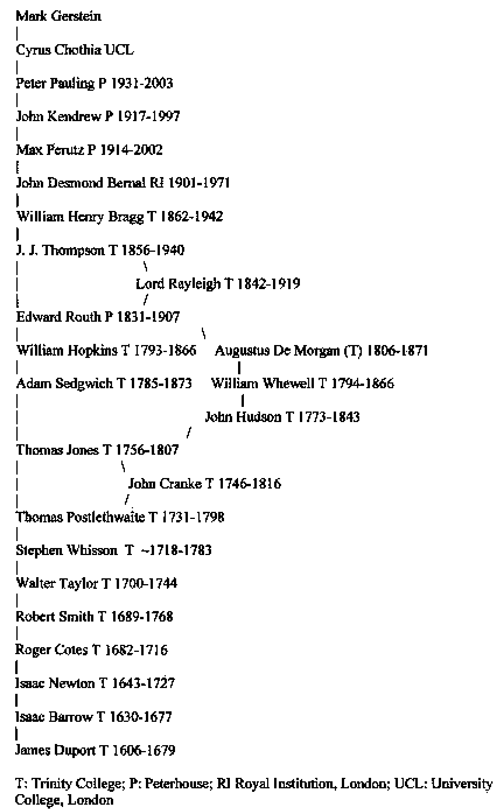
Image of my academic genealogy back to Newton , with a mere 18 links ! (courtesy of C Chothia)
**1.** Mark Gerstein
2. Cyrus Chothia UCL (+ R Lynden Bell)
3. Peter Pauling P 1931-2003
4. John Kendrew P 1917-1997
5. Max Perutz P 1914-2002
6. John Desmond Bernal RI 1901-1971
7. William Henry Bragg T 1862-1942
8. J. J. Thompson T 1856-1940
- - - I Lord Rayleigh T 1842-1919
9. Edward Routh P 1831-1907
10. William Hopkins T 1793-1866
- - -Augustus De Morgan (T) 1806-1871
11. Adam Sedgwich T 1785-1873
- - - William Whewell T 1794-1866
- - - John Hudson T 1773-1843
12. Thomas Jones T 1756-1807
- - - John Cranke T 1746-1816
13. Thomas Postlethwaite T 1731-1798
14. Stephen Whisson T ~ 1718-1783
15. Walter Taylor T 1700-1744
16. Robert Smith T 1689-1768
17. Roger Cotes T 1682-1716
**18.** Isaac Newton T 1643-1727
Isaac Barrow T 1630-1677
James Duport T 1606-1679
T: Trinity College; P: Peterhouse; RI Royal Institution, London; UCL: University College, London
 Labels:
bioinformatics,
doc,
fact,
fun
Labels:
bioinformatics,
doc,
fact,
fun
We read with great interest the recent article in Nature about the
difficulties in data sharing and archiving ("Empty Archives"). While the author discusses database archiving in detail, he neglects to consider the important archival role
served by academic journals. When it comes to archiving, journals are
more than disinterested third parties. They have historically been, and
continue to be, the central actors in scientific communication. As such,
journals should take the lead in devising and implementing standards
that will allow data from disparate fields to be shared and exchanged.
They should also embrace data sharing as part of the publication
process. Note that this is very much the viewpoint taken in the
companion article in the issue from the Toronto Data Release Workshop.
Although journals have historically sought to provide a permanent record
of scientific advance, many of the problems that we now face in relation
to data archiving and sharing stem from the fact that the publication
process with its varied, idiosyncratic formats often seems purposefully
divorced from this archiving role. It is time for journals to devise
universal structured versions of articles and appendices that
accommodate - and archive -- large data sets. This is no small task, and
it is no doubt larger than any one journal or editorial board. But
while daunting, such progress is necessary to preserve the value and
relevance of journals - and the fundamental service they provide - as we
move into a database-driven future.
Dov Greenbaum JD, PhD
Michael Seringhaus PhD
Mark Gerstein PhD
Labels:
L2E,
UnpublishedLetter
Here I've collected various things related to some trips to Europe in 2009.
* Pictures
Flickr photos galleries from London in Jan., Belgium in Oct., and Paris & Cambridge in Dec. (The analogous links in picasa: London, Belgium, & Paris .)
In addition to the usual tourist shots, I took some fairly abstract photos and some more general "concept" ones. My photos also added significantly to my burgeoning McDonald's photo collection.
* Tags & Routes
I tagged my photos quite extensively. Here's a listing of some of my more commonly used tags on the trips. One 'tag group' that was particularly hard to shoot were the panoramas and nighttime photos , where I was aided by my trusty new Sony. Here's an almost 360' panorama of the Louvre.
As might be expected, I geotagged many of the photos as well; thus, each of these galleries is associated with a nice map link -- e.g. here's an one for Paris . The geotagging has the side benefit of providing some tracks of where I went, viz: walking around Paris, Paris to London (via Chunnel), & walking around London (not necessarily in order).
* Links & Lectures
Here's a general collection of links of random information associated with the trips.
Some lectures that I gave during the trips: 1a, 1b, 2, 3, 4
Some of my own cryptic internal IDs with yet more links: i0wtsysbio, i0gencwinter08, i0vib
Labels:
fun,
FunTaggedTrips,
routes-timings
Some quotes I liked from: http://www.newyorker.com/reporting/2009/10/05/091005fa_fact_cassidy
For more see: http://delicious.com/mbgmbg/clust_bridge_keynes_quotes
Millennium Bridge
It initially closed in '00 then reopened: "The real problem was that the designers of the bridge... had not taken into account how the footway would react to all the pedestrians walking on it."
Keynes view on our "third degree" guesses
Keynes’s jaundiced view of finance reflected his own experience as an investor .... He compared investing to newspaper competitions in which “the competitors have to pick out the six prettiest faces from a hundred photographs, the prize being awarded to the competitor whose choice most nearly corresponds to the average preferences of the competitors as a whole; so that each competitor has to pick, not those faces which he himself finds prettiest, but those which he thinks likeliest to catch the fancy of the other competitors, all of whom are looking at the problem from the same point of view.... It is not a case of choosing those which, to the best of one’s judgment, are really the prettiest, nor even those which average opinion genuinely thinks the prettiest... We have reached the third degree, where we devote our intelligences to anticipating what average opinion expects the average opinion to be. And there are some, I believe, who practice the fourth, fifth and higher degrees.”
Points on the Prisoner's dilemma
Because financial markets consist of individuals who react to what others are doing, the theories of free-market economics are often less illuminating than the Prisoner’s Dilemma, an analysis of strategic behavior that game theorists associated with the RAND Corporation developed during the early nineteen-fifties....
Imagine that you and another armed man have been arrested and charged with jointly carrying out a robbery. The two of you are being held and questioned separately, with no means of communicating. You know that, if you both confess, each of you will get ten years in jail, whereas if you both deny the crime you will be charged only with the lesser offense of gun possession, which carries a sentence of just three years in jail. The best scenario for you is if you confess and your partner doesn’t: you’ll be rewarded for your betrayal by being released, and he’ll get a sentence of fifteen years. The worst scenario, accordingly, is if you keep quiet and he confesses.
What should you do? The optimal joint result would require the two of you to keep quiet, so that you both got a light sentence, amounting to a combined six years of jail time. Any other strategy means more collective jail time. But you know that you’re risking the maximum penalty if you keep quiet, because your partner could seize a chance for freedom and betray you. And you know that your partner is bound to be making the same calculation. Hence, the rational strategy, for both of you, is to confess, and serve ten years in jail. In the language of game theory, confessing is a “dominant strategy,” even though it leads to a disastrous outcome.
Labels:
quote,
textstream_blog_additional_info0mg
We read Katrina Voss's article on open access to genomic information (22 August, p 22) with great interest. Summing up her argument, she quotes her father: "I'm not worried, I'm just not that important."
Narcissists aside, we can all agree that we aren't that important to the rest of the world. However, what Voss fails to account for is the small cadre of people to whom we are that important. This set includes friends, relatives, employers, potential mates, and even stalkers who already look at the wealth of information available online.
One instance where this data could be misused would be by adopted children, or even the children of sperm donors, to find parents who might not want to be found.
Similarly, certain professions could be affected from the outset. Genomics has the potential to touch all aspects of sport, from using genetic information for draft picks, to mandatory genetic testing to screen out players at all levels of the game at risk of serious and unanticipated ailments.
With the growth in understanding the links between athleticism and genetics, public disclosure of personal genomic information of athletes may be just a logical extension of what is already in place. Analysing how athletes deal with this new form of personal information will be of particular interest to the rest of society as it learns how to manage the eventual disclosure of personal physical and genetic information.
Dov Greenbaum & Mark Gerstein, New Haven, CT
Labels:
L2E,
PublishedLetter
Supposedly....
Turtle is symbol of:
Patience longevity connection
Rabbit is symbol of:
Patience quick thinking timidity ingenuity fertility
Salmon is symbol of:
Determination fertility wisdom prophecy
Frog is symbol of:
Transformation creativity fertility water
Labels:
quote